For engineers and founders
The best engineers are athletes now
Why the top of the engineering market started behaving like a sports market, and what has to get built now that it has

The top of the engineering market has become a sports market, and almost nothing around it has adjusted.
A handful of people can change the outcome of a company. Compensation packages increasingly resemble player contracts, and deals have started to look like trades. When a well-known researcher changes labs, people follow the move the way they follow a signing.
Yet the recruiting industry still treats its job as filling seats. It doesn’t scout or represent careers, and it rarely has a view on whether a particular company is the right place for a particular person to spend the next three years of their life.
The engineers are already athletes, and the apparatus around them is still a staffing agency.
The strangest consequence is that many of the best engineers in the world are unrepresented.
The market already made this argument
Meta spent the summer of 2025 assembling its superintelligence lab the way an owner rebuilds a roster. The reported packages were franchise-player numbers. Some researchers accepted them and others reportedly refused, and the refusals became news.
People don’t usually turn down jobs in public, so the refusals read like players turning down contracts.
Then there were the trades. Google paid a reported $2.4 billion in a licensing deal with Windsurf that brought Varun Mohan and several members of his team into Google. Meta invested $14.3 billion in Scale AI and brought Alexandr Wang over to lead its new lab. Microsoft struck a similar licensing and hiring deal with Inflection to bring in Mustafa Suleyman. Google had already used the same structure with Character.AI to bring Noam Shazeer back.
Some of these deals look odd as corporate transactions. They make sense as one franchise paying another for the rights to a few players.
The same pattern now shows up across nearly every important subfield. The people inside it can usually recite the short list of names who matter. When one of them moves, the move itself becomes news. This kind of short, public ranking was once mostly confined to professional sports.
Why it happened now
Engineering output has always followed a power law. The tools widened the gap and made it easier to see from the outside. One excellent engineer working with today’s tools can ship what took a team of five a few years ago.
The bigger change is that many of the best companies are staying small on purpose so each seat carries more weight, which is how roster economics work.
The headlines come from a few dozen researchers at frontier labs. The mechanics reach much further down the market than the money does.
The roster is the company
At a startup with fewer than a hundred people there’s no real bench, and the first ten engineers are the team. The tenth hire helps set the ceiling for the eleventh because strong people want to work with strong people, while merely good people rarely object to working with other merely good people.
A mediocre senior hire on a team of ten doesn’t arrive with an alarm attached, and the damage stays invisible for a while. The company gets a little slower, the standards get softer, and the next great engineer becomes harder to recruit.
Founders are already doing the job of a general manager whether or not they use the term. They are deciding who should be on the floor when it matters, who makes the people around them better, and who they would trust to build around.
Most still run an HR process because it’s what they saw at their last company: write a job description before knowing who might take the job, publish it, build a pipeline, run panels, compare scorecards. That machinery was designed to fill seats inside large systems that can absorb a hiring mistake.
It’s bad at seeing what decides a startup’s season: what this person will build when no one asks, how quickly they can move through a problem nobody has framed, and whether they would run toward this founder’s particular kind of intensity or away from it.
Scouting departments exist because serious franchises don’t wait for applications. They pay people to watch the work and know who is good two years before it becomes obvious.
Tech has sourcing, where the same indexes get searched for the same keywords and the same list of people comes out of them.
Software has game film too: the code someone wrote, the products they shipped, the decisions they made when the obvious approach failed, and the people who worked beside them and are willing to stake their own reputation on what they saw.
Then there are agents, the institution engineering never built.
A recruiter is paid by the club
A recruiter is paid by the company, against a requisition, on the company’s timeline. The tools of the trade are built for volume: sourcing lists, sequences, submissions and placements. The open seat sets the terms.
That model was reasonable when even strong engineers were treated as interchangeable professionals and hiring was largely statistical. A large company can be slightly wrong a thousand times a year and average it out.
AI breaks the volume model. Outreach costs almost nothing, so everyone sends more of it, less of it gets read, and it stops signaling much of anything. Sourcing tools pull from the same indexes, so everyone sees the same people.
An agent is paid by the career
An agent knows the player’s game before there is a deal on the table. They know what the person is great at, what they are merely good at, and what kind of system would waste them. That knowledge comes from paying attention while nothing is happening, so an agent can move quickly when something finally does.
An agent also knows the league: which teams make people better and which burn them out, which founder you would bet two years of a career on, and which offer is a large number attached to the wrong season, the one you take at twenty-nine and regret at thirty-two.
Most of the job is saying no on the player’s behalf, which is what gives a yes its weight. The person on the other end of the call knows the agent doesn’t arrive with junk or manufacture urgency for a deal they wouldn’t recommend to their own client.
The incentives have to run in years, because the relationship is the asset and a bad deal loses the player, then the reputation, then the next player.
There’s an obvious incentive problem here. Zelcast is paid by the company today, and the easy path from there is to treat the open role as the customer and the engineer as inventory.
We think the fee can come from the company while the relationship still belongs to the engineer. That means knowing someone before a requisition exists, advising them to stay where they are when staying is right, and declining a placement that might pay us now but would damage the relationship later. If we’re serious about building an agency, we have to be willing to make that trade.
Set this against what a great engineer usually has today: an inbox full of automated follow-ups from people who have never read a line of their code, and nobody whose job is to think about their career from the outside.
For a market this mature, that’s a strange state of affairs, and it won’t last.
The founder needs the same thing from the other side
A founder hiring the first ten engineers doesn’t need more resumes. At that stage fifty resumes are fifty distractions from the one seat that matters, and they tell the right person they are being processed.
The founder needs someone who is already in the rooms and knows who is great, who can bring one person whose fit with this founder and this company should hold, and who will say plainly when nobody fits.
That’s agent work viewed from the other chair: know the players and the rooms, make very few introductions, each with a real argument behind it, and be judged by how they turn out.
A firm built on the old economics struggles to work this way. Its people have the judgment, but the compensation rewards more placements, and the rest of the firm eventually follows the compensation.
The league is already legible
We stopped treating this as a metaphor when we mapped the market.
Our dataset covers 26,572 engineers and the jobs they have held. The most common move between any two companies in it is Google to Meta, with 194 people making the jump.
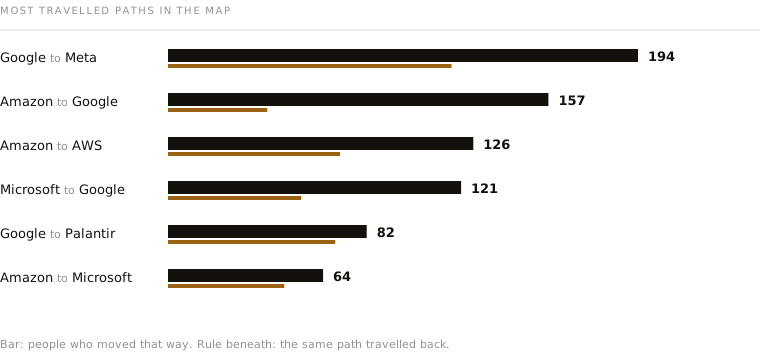
We found 75 former Palantir engineers whose next recorded role was as a founder. Half started their company within a month of leaving, so they weren’t taking time off to figure out what came next.
On our internal measure of early-stage engineering strength, the people who left Palantir scored higher than the people who stayed: 87 versus 83. Only five moves out of Anthropic appear in the dataset so far.
None of this appears in a job description, and it’s the kind of information someone should want before signing one.
The questions that matter are where great people tend to go next, which companies produce founders, which teams retain their best people and which lose them, and who is underrated because the market hasn’t caught up to the work yet.
Where this goes
Markets for scarce talent eventually build institutions around the talent. Sports developed scouts, game film, agents and transfer markets, film built agencies, and music built managers and A&R. Once one person’s ability can change the economics of an entire project, finding and representing that person becomes an industry of its own.
The market for the top one percent of engineers is moving in that direction quickly.
Zelcast is our attempt to build that agency.
We want to know exceptional engineers before a role exists, understand the rooms where their careers will compound, and make a single introduction with a specific case for it.
Sometimes the right answer for an engineer will be to stay put, and sometimes the answer for a founder will be that we don’t know anyone good enough. If we never say either, we’re still running a staffing firm.
The best engineers are already priced and traded like athletes, and soon they will be scouted, evaluated and represented like them too.
Common questions
- Why are top engineers being compared to athletes?
- Because the top of the market already behaves that way. A handful of people can change the outcome of a company, compensation increasingly resembles player contracts, and deals have started to look like trades. When a well-known researcher changes labs, people follow the move the way they follow a signing.
- What is the difference between a recruiter and an agent?
- A recruiter is paid by the club: against a requisition, on the company’s timeline, with tools built for volume. An agent is paid by the career. They know the player’s game before there is a deal on the table, and most of the job is saying no on the player’s behalf, which is what gives a yes weight.
- Do software engineers have agents?
- Almost none of them do. What a great engineer usually has is an inbox of automated follow-ups from people who have never read a line of their code, and nobody whose job is to think about their career from the outside. Sports built agents, film built agencies and music built managers, but engineering hasn’t built its own yet.
- How should a startup hire its first ten engineers?
- The way a general manager would. There is no real bench at that size, and the tenth hire helps set the ceiling for the eleventh. A mediocre senior hire doesn’t arrive with an alarm attached. The standards just get a little softer and the next great engineer becomes harder to recruit.
- Which companies produce the most startup founders?
- Palantir is the clearest case: 75 former engineers whose next recorded role was as a founder, and half started within a month of leaving. The people who left score higher than the people who stayed, 87 versus 83. The full picture is on the alumni map, company by company.