For founders
Talent is the only moat left
When a product can be rebuilt in weeks, the people who build it are the advantage that lasts
As of October 2026, most of what used to protect a software company has stopped working. Code is cheap to write and cheap to copy, customers switch vendors on a month’s notice, and the best product this week can be second best next week. What still compounds is the team. At an early-stage startup the team is most of the company, which makes talent the one moat a competitor can’t simply rebuild.
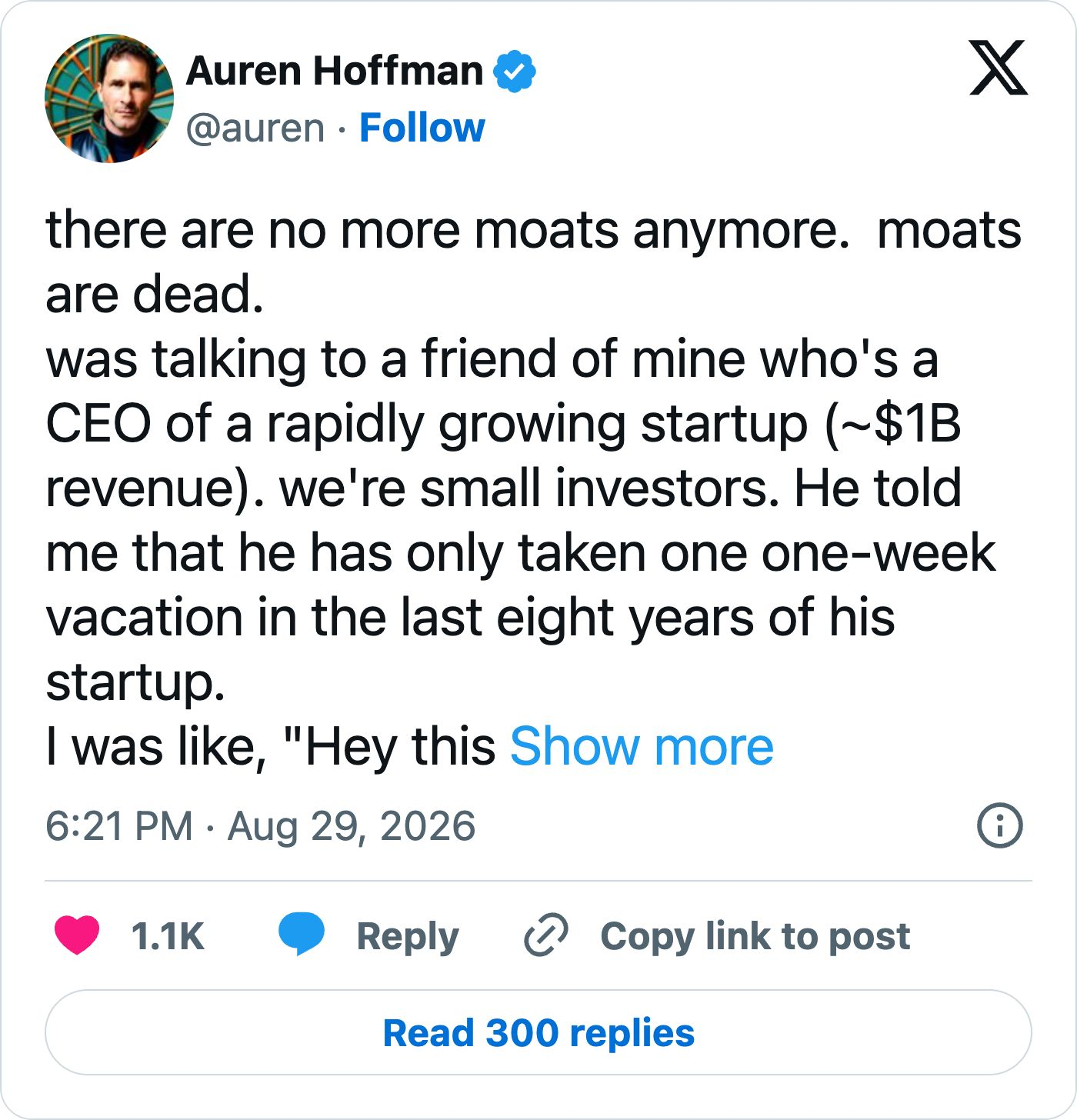
Two posts this fall made the case from different directions. In August, Auren Hoffman, a general partner at Flex Capital, wrote that moats are dead. A friend of his runs a startup doing about a billion dollars in revenue and has taken one week of vacation in eight years, because his customers are some of the smartest buyers in the world and would leave the moment a competitor shipped something better. Auren then looked at how the 200 companies in Flex’s portfolio buy software and found almost every vendor on a month-to-month or usage-based contract. Nobody signs for a year when they don’t know what they’ll be using in two months.
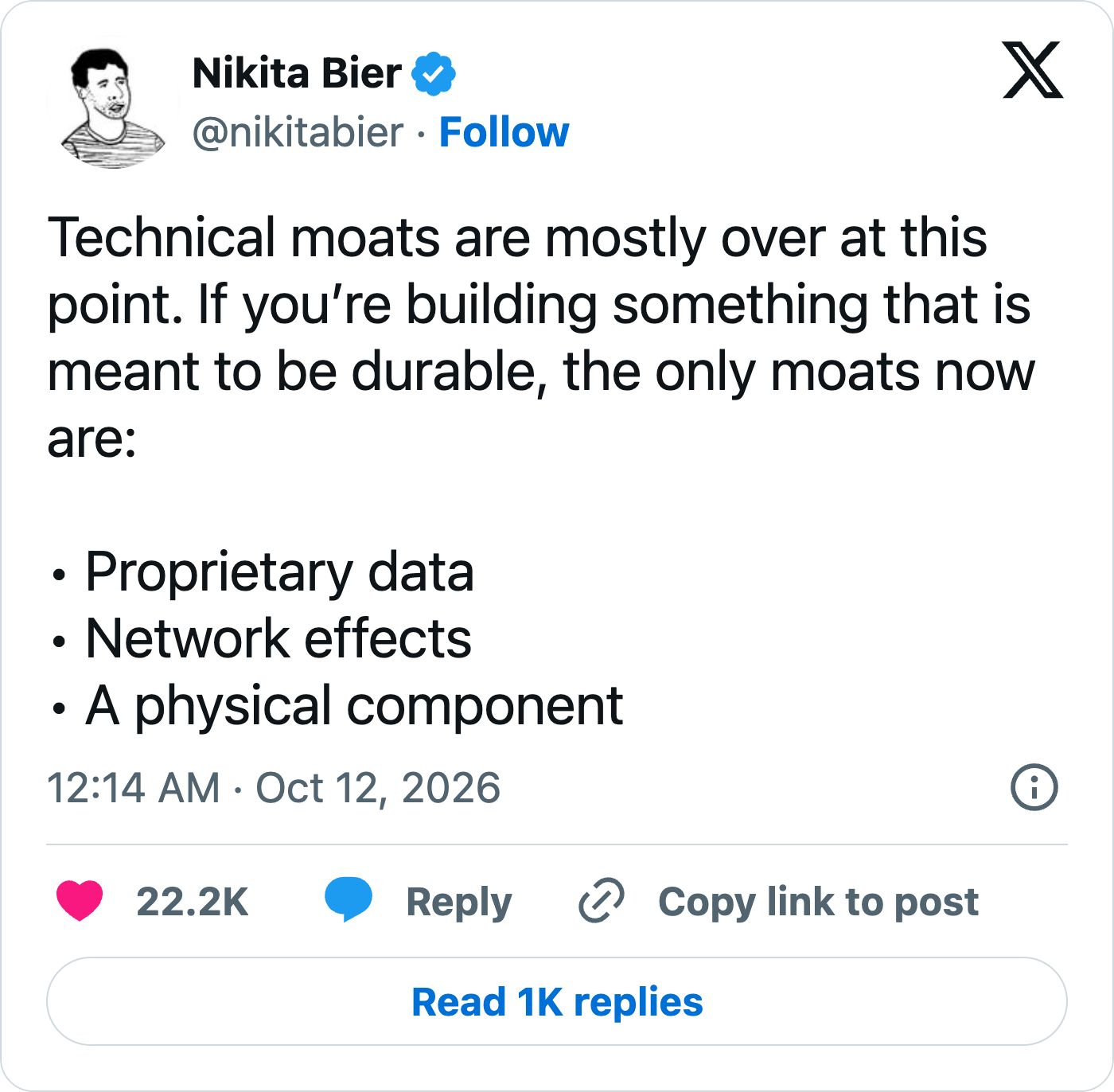
On October 12, Nikita Bier put it more bluntly. Technical moats are mostly over, he wrote, and the only durable ones left are proprietary data, network effects and a physical component.
Why the old moats stopped working
Most of what protected a software business was friction. Ripping out a system was painful, so customers lived with a mediocre one for years. Integrations took a quarter to rebuild. The team that wrote the code was the only team that understood it. AI took most of that friction away at once. A capable team can now rebuild a competitor’s product in weeks, the new vendor’s tools handle the migration, and switching costs that took a decade to build can disappear in a sprint.
What the list leaves out
Look at the three moats that are left. Proprietary data has to be gathered by someone who knew which data would matter before anyone else did. Network effects start with a product good enough that the first thousand users stay, which comes down to decisions a handful of people make. A physical component means hardware, supply chains, factories and regulators, which is some of the hardest engineering there is. All three are things a great team builds.
So the competition has moved one step earlier, to who you hire. When any feature can be copied, the advantage goes to the team that keeps shipping the next one faster than everyone else. Auren’s friend works the hours he does because the product is all that protects him. A company with ten exceptional engineers can make that pace normal instead of heroic.
Why it matters most at the start
The first ten engineers at a startup set its architecture, its speed and its standards, and then they hire the next fifty. A mediocre hire at a large company is a rounding error. At a seed-stage startup it’s a tenth of the company. As AI makes each strong engineer several times more productive, the gap between the right ten people and the wrong ten keeps getting wider.
It’s also the one advantage a competitor can’t copy over a weekend. A codebase can be cloned and a feature list reproduced. A team that trusts each other and has learned to ship together took years to put together, and the people on it rarely come back on the market.
What founders should do about it
Treat hiring as the product decision it has become. Spend founder time on the first ten. Look past the categories a resume fits into, five years of this or ex-somewhere, and at what a person has actually built and what they’d run toward. And move quickly when the right person is ready, because the best engineers are usually off the market within days of deciding to look.
This is the work we do at Zelcast. Our mission is to make sure the first ten engineers at the most consequential startups of the next decade are chosen for the things that actually matter, by people who know how to see them.
Common questions
- Do software companies still have moats in 2026?
- Fewer than they used to. Code is cheap to reproduce, switching costs have collapsed, and most companies now buy software month to month. The durable advantages left are proprietary data, network effects, a physical component, and the team that builds all three.
- Why is talent a moat?
- It is the one input a competitor cannot copy. A product can be rebuilt in weeks. A group of exceptional people who have learned to ship together takes years to assemble, and its members rarely come back on the market.
- What should an early-stage startup do about it?
- Treat the first ten engineering hires as the most important product decision the company makes, spend founder time on them, judge people on what they have actually built rather than the categories on their resume, and move quickly when the right person is ready.